
Introduction
Over the past 10 years we've had the privilege of supporting hundreds of organizations through their change initiatives. What if we could use that experience to uncover shared insights into what makes change successful and provide benchmarks?
We decided to take a detailed look at the most frequent "best shared" opinions and ideas (what we call synthetrons) about the change process across multiple online dialogue sessions, to uncover new insights into what makes change successful (see methodology below).
The 3H model
When screening these core messages, we identified some systemic, recurring change drivers that we categorize in an anthropomorphic way: Head, Heart and Hands (3H).
We learned that during change, people need to be convinced of the rationale for change, to analyze it and think it through (Head); they also need to believe in it, be emotionally drawn to it, and be aware of the accompanying behavioral and cultural changes needed to make it work (Heart). Finally, they consistently talk about the ability to implement it by having the necessary means, resources and tools (Hands). This is how our 3H model came about.
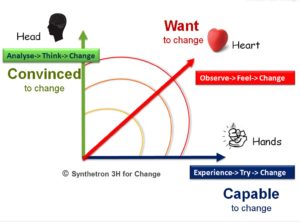 Synthetron 3Hs model
Our 3H model in short
- Head is about the rationale for change, the need to be convinced of the change: the alignment
- Heart is about the soft side of change, the need to believe in the change: the engagement
- Hands is about the hard side of change, the ability to make the change happen: the implementation
What did we learn about the 3 H's?
1. Change needs focus on all 3 H's
There wasn't a single dialogue in which all 3H's weren't present in some way. People always talk about the need to embrace the rationale, to be convinced of the necessity/believe in the way forward, but also want to be able to make the change happen.
2. "Hands" — the ability to make the change happen — needs the most attention
About half of the comments related to change are about Hands, 30% are about Heart and 20% about Head. From a management perspective, "Hands" is less sexy, but Hands is linked to daily reality and is what counts for those who have to undergo and make the change happen.
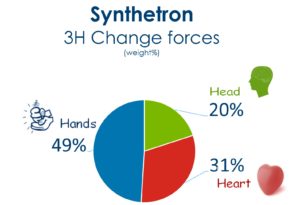 3H Change drivers ratios
Deviations from the benchmark (average weight from the database) are surprisingly small. When we noticed an underrepresentation of one of the 3H change drivers, content analysis taught us that this was usually the result of poor "performance" on one of the H's for the organization in question.
3. Underperforming on one of the 3 H's is like driving with the handbrake on
You simply cannot compensate for underperformance on, say, Heart — the behavioral part, the role modeling — by overcompensating on Head — explaining why the change matters — because people will understand you, but they won't believe you.
We once worked with a manager who had put a great deal of effort into explaining the change story, the rational part. He really went out into the field, held town hall meetings, put up notice boards, sent newsletters, etc., to explain that the company would from now on focus on market A. But because the reward system still rewarded results in market B more than in A, nobody believed him, and extra effort wouldn't have helped. The motivation simply wasn't there. If the systems, processes and investments in competencies (Hands) are missing, people may be convinced or even engaged, but they simply lack the ability to make it happen.
4. Consistency is key — people undergoing change spot inconsistencies immediately
We see so often that when a manager doesn't practice what he preaches (Heart), people stop believing him/her and alignment gradually erodes. Similarly, we had a case where the strategic/change direction was unclear (Head). The CEO focused on culture change and new behaviors, and many activities were set up, which created positive energy and engagement. But because his management team didn't understand which direction they were supposed to go, because the CEO hadn't made the strategy explicit (Head), people weren't aligned. Despite all the efforts to create engagement, the organization didn't move forward.
If the systems, processes and investments in competencies (Hands) are missing, people may be convinced or even engaged, but they simply lack the ability to make it happen.
5. Phasing 3H change efforts is counterproductive
Classic phasing is about first telling the change story, then organizing events to motivate people, and then expecting them to change/implement.
However, although the 3H's on average carry a different weight depending on the phase of the change initiative (planning, implementation, debriefing), our data clearly shows that all 3H's need attention from start to finish. People also want to feel the change (Heart) when they're told things need to change. They want to be reminded, in the middle of execution, of the bigger project they're contributing to (Head). They want to see, from the very start, what investment (Hands) will support the change.
6. Hands is about more than material things: it also covers people's capabilities
Hands is about processes, budgets, systems, but also about people's skills and capabilities. This includes classic training, building competencies, freeing up time, finding the right profiles, but also working on stamina, energy, and the ability to motivate yourself for the next change.
How did we build the 3H model?
We built a fully anonymized database to quantify, qualify and further investigate the key drivers of successful change. This database today includes more than 21,000 "synthetrons" (typically the top 15% most important ideas identified by participants during the online dialogues) from more than 200 sessions organized on behalf of 50+ companies.
Today, our consultants use the 3H model to help our clients benchmark their change initiative and identify key priorities for success.